Car A/C diagnosis · A Triton guide
Published
Why is my car A/C only cold when driving?
If your car’s A/C cools while driving but turns warm at a stop, the change is a useful diagnostic clue. Airflow through the condenser deserves attention, but refrigerant and compressor-control problems can also affect cooling. The symptom alone does not prove that you need a fan, a recharge or a new compressor. For Fairfax drivers, a clear description of when cooling changes helps the shop plan the right assessment.
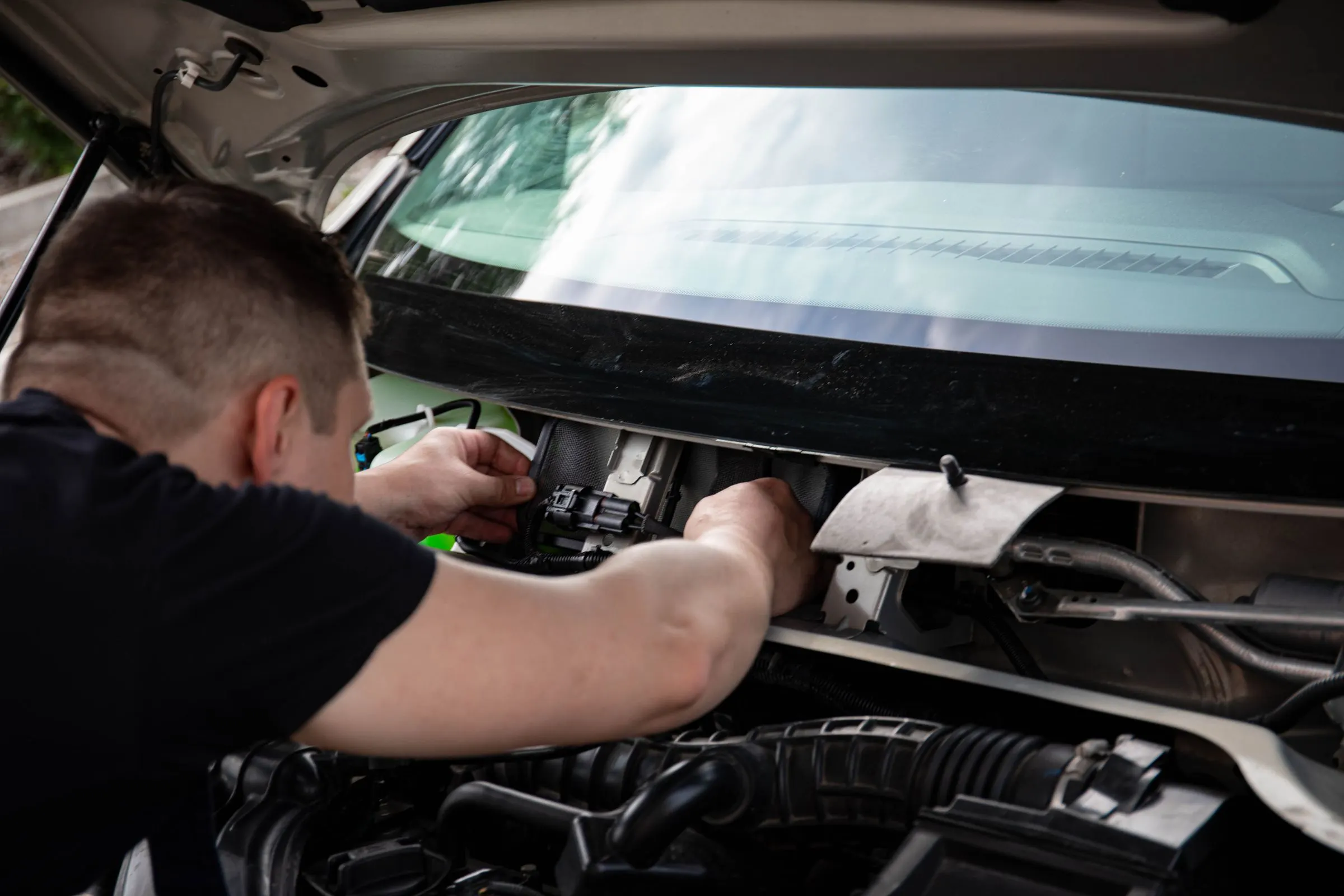
Illustrative automotive-service photo by Sergey Meshkov / Pexels. This is not Sal, the Triton shop or a documented A/C repair.
Why stopping can change the cooling
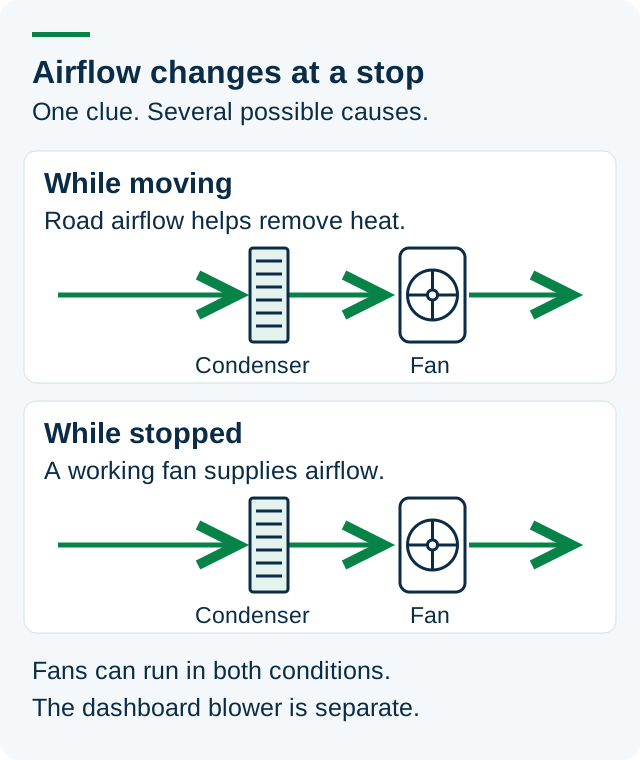
The condenser releases heat from the refrigerant into outside air. In a conventional front-mounted arrangement, vehicle movement helps air pass through the heat exchangers; a cooling fan supplies airflow when road airflow is insufficient. A problem in that airflow path can become more noticeable at a stop.
There are two different airflows to describe. The cabin blower moves air through the vents toward you. The cooling fan outside the cabin moves air through the heat exchangers. Strong air from the dashboard does not establish that the condenser is getting the airflow it needs.
Treat “cold while moving, warm while stopped” as a condition to reproduce, not a diagnosis. Layouts and control strategies vary. The fan may operate while driving too, and not every vehicle has a separate condenser fan.
- Technical reference: HELLA: how the condenser releases heat.
- Technical reference: DENSO: heat exchangers and cooling airflow.
- Technical reference: DENSO: shared and dedicated condenser fans.
Record the pattern before your visit
A useful report is more specific than “the A/C sometimes works.” Note what you have already noticed during normal use. Write it down after parking safely; do not handle your phone while driving or create a roadside test.
Also explain whether cooling returns immediately when traffic moves or only after several minutes. If the problem happened on a warmer afternoon but not on the morning of your appointment, tell the shop. An intermittent complaint needs its original conditions described even when it is behaving normally at drop-off.
- Does the air keep blowing strongly while its temperature rises, or does the airflow itself weaken?
- Does it happen at every stop, only after a long drive, or after the car has been parked in the sun?
- What temperature, fan speed, recirculation and automatic-climate settings were selected?
- Were there unusual sounds, warning messages or changes in the engine-temperature display?
- Has anyone added refrigerant, replaced A/C parts or worked around the front of the car recently?
Check airflow before condemning the compressor
Ask whether the technician checked the condenser’s condition and fan operation under the conditions that produce the complaint. DENSO’s troubleshooting chart identifies dirty heat-exchanger fins and poor fan airflow among possible reasons for abnormal system pressures. It also lists other causes, so a pressure reading needs context.
If a fan is not operating as required, the next question is why. Ask whether the fault is in the fan itself or its supply and control, and what testing established that distinction. A parts quote should follow the finding; seeing a stationary fan once is not enough to identify a failed motor.
Do not reach into a fan assembly, bypass a control or open a refrigerant connection to try to prove the cause. Leave the running-system checks to the technician. Your useful contribution is the symptom history and any previous repair paperwork.
Technical reference: DENSO: possible causes behind A/C pressure findings.
A recharge is not the automatic next step
Refrigerant quantity can affect performance, but poor cooling is not a measurement of how much refrigerant is in the system. Both insufficient and excessive charge appear in DENSO’s diagnostic chart. Adding more on the assumption that “warm means low” can send the repair in the wrong direction.
Ask how the existing charge will be assessed and whether leak testing is indicated. If testing identifies a leak, the proposal should explain its location and the repair needed. Simply restoring cooling for a short time does not show that a leak has been repaired.
Bring invoices from previous top-ups, including any listed refrigerant, oil or additives. HELLA’s service guidance specifies using the vehicle manufacturer’s refrigerant type and quantity. There is no single fill amount or universal pressure target that applies to every car covered by this article.
- Technical reference: DENSO: low-charge and excessive-charge findings.
- Technical reference: HELLA: vehicle-specific pressure, refrigerant and oil requirements.
Read the broader guide to warm A/C, leaks and repair options
Hybrids and EVs need the right compressor assumptions
A conventional belt-driven compressor and an electric compressor do not operate in the same way. DENSO explains that its electric compressor uses its own motor and can run independently of the combustion engine. Where that design is fitted, a hybrid’s engine switching off does not by itself explain a loss of A/C cooling.
For a specific example, Tesla’s current US Model 3 manual describes climate operation in Park and notes that the system is powered by the high-voltage battery. A Model 3 does not need gasoline-engine speed to run its A/C. Its manual also describes settings and operating limits; consult the version applicable to your vehicle rather than assuming every Tesla or model year behaves identically.
Send the exact year, model and any climate-system alerts. Electric-compressor service requires the correct oil specification and contamination controls; DENSO highlights the oil’s electrical-insulation role. Do not apply a generic oil recommendation to your hybrid or EV, or attempt work on high-voltage equipment.
- Technical reference: DENSO: electric-compressor operation and oil requirements.
- Technical reference: Tesla Model 3 US manual: operating climate controls.
What should support a compressor replacement quote?
A useful explanation connects your complaint to the test results. Ask what supports compressor failure rather than an airflow, refrigerant or control problem. If the evidence is incomplete, agree on the next diagnostic step before approving a major parts replacement.
If compressor damage is confirmed, ask whether contamination or another fault also needs attention. HELLA’s replacement guidance explains why contamination and the correct oil and refrigerant matter. The required work depends on the system and findings, not just the name of the part being replaced.
Ask how the shop will verify the result under the original conditions, including stopped operation where appropriate. A cold vent reading from a moving car would not, by itself, resolve a complaint that only occurs while stopped. Keep the findings and approved scope with your service records.
Technical reference: HELLA: compressor diagnosis and replacement considerations.
Common questions about warm A/C at a stop
Can I keep driving if it becomes cold again? That change does not establish the car’s condition. If overheating, a stop-vehicle warning, smoke or other serious symptoms accompany it, stop safely and follow the vehicle’s instructions. Do not drive faster to mask a cooling problem. Discuss the symptoms before setting off for the shop.
Does this mean the compressor is worn out? Not by itself. Ask for the evidence that distinguishes a compressor fault from the other possibilities. A diagnosis should explain the proposed work, not simply repeat the symptom.
Will it be a small repair or a major one? That depends on the confirmed cause, vehicle configuration, parts, access and labor. Triton does not publish a generic price or range for this symptom. Diagnosis is included with the repair; ask about any standalone testing charge first.
Arrange A/C diagnosis from Fairfax
Triton serves Fairfax and Northern Virginia from one shop at 8419 Terminal Rd, Lorton, VA 22079. When arranging a visit, say that cooling changes at a stop and share the conditions you recorded. Send the vehicle year, make, model and earlier A/C invoices so the assessment can start with the right history.
Confirm the drop-off plan before traveling from Fairfax. An intermittent fault may need time to reproduce; discuss timing and arrange return transportation without assuming an immediate repair. If warnings or other symptoms make driving uncertain, discuss transport first.
Call (571) 325-1369 or request a quote. We service all hybrid makes and models, Tesla electric vehicles and regular gas vehicles, excluding diesel. We explain the findings and obtain approval before repairs. Ask for the written warranty applicable to your specific A/C work.
Questions to bring to the shop
- Were you able to reproduce the change between driving and stopped operation?
- What did the airflow, refrigerant and control checks establish?
- What evidence supports the proposed part replacement?
- How will the repair be checked under the original conditions?
- What scope, timing and written warranty am I approving?