
Hybrid battery diagnosis · A Triton guide
Published
Why does my hybrid battery charge go up and down?
Some movement in a hybrid battery charge display is part of how the vehicle manages stored energy. A gauge that changes does not, by itself, establish a failed battery. A new or repeated change in behavior deserves context: which display you are watching, what the car is doing, and whether warnings or other symptoms appear. For Woodbridge drivers, the useful next step is to document the concern and arrange an assessment when needed, rather than choose a battery from the number of bars.
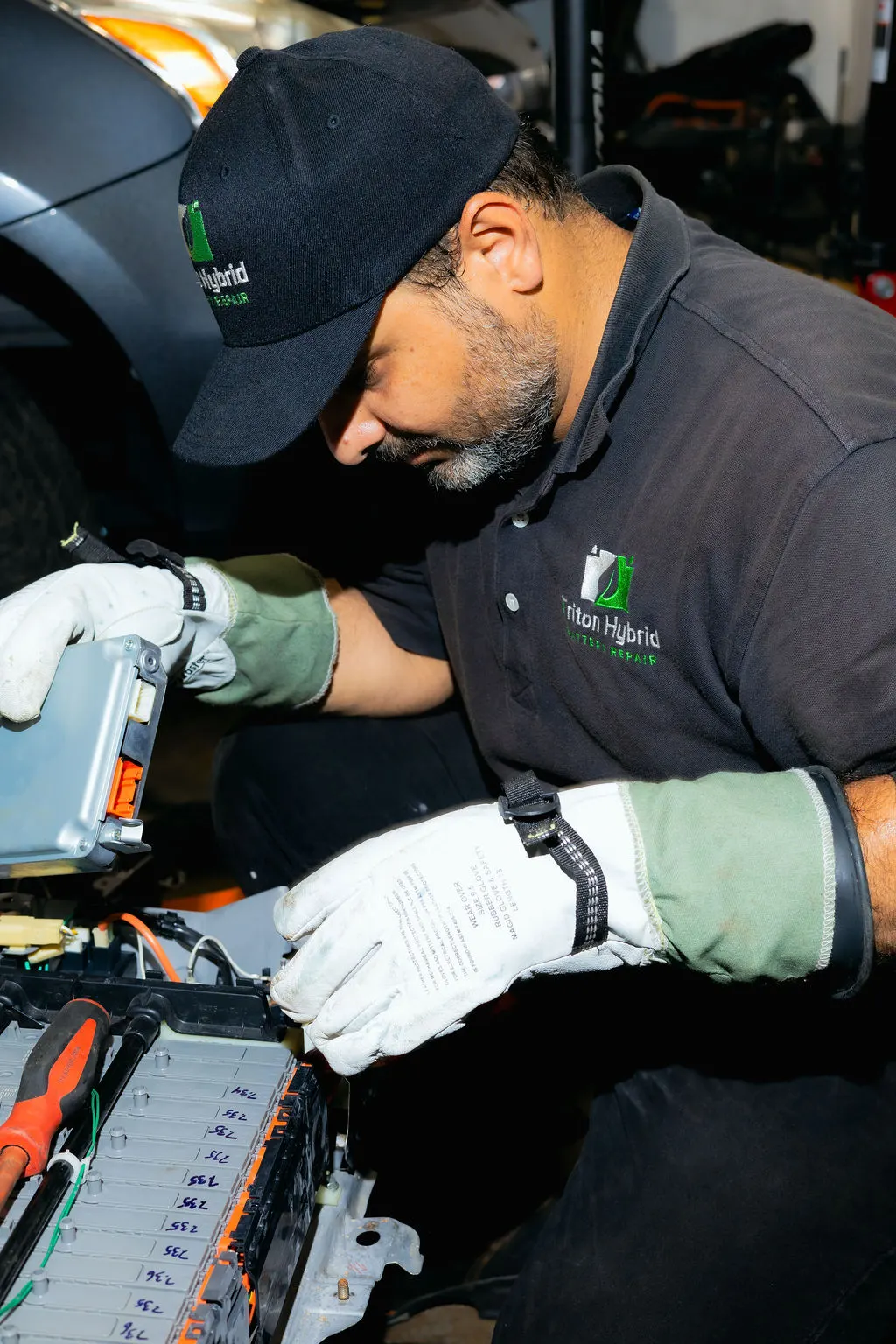
Existing Triton workshop photograph of battery service, not a customer case involving a fluctuating charge display.
Which display are you watching?
Begin with the exact vehicle year, model and screen. A traction-battery charge display, a fuel-economy display and an energy-flow graphic answer different questions. If you are unsure which one changed, identify it in your owner’s manual or show the shop a photograph taken while safely parked. Do not compare bars on two different vehicles as if they were the same measurement.
Toyota’s Prius owner’s manual OM47E01U, page 126, describes eight display levels for the remaining traction-battery charge. It also explains that the hybrid system controls that charge automatically; the display need not reach its highest level even when energy is being recovered or generated. That specific display behavior is not a fault by itself.
This Prius example is not a specification for every hybrid, plug-in hybrid or electric vehicle. Use the manual supplied for your own car. In particular, do not transfer a Prius bar-count rule to a Tesla battery percentage or assume that a plug-in vehicle’s electric-range estimate means the same thing.
Technical reference: Toyota Prius owner’s manual OM47E01U, page 126: charge display and automatic control.
Does a changing gauge mean the battery is worn out?
A charge display is not a repair recommendation. The question “how much charge is displayed now?” differs from “what condition is the battery in?” A picture of a low reading cannot answer the second question on its own. Neither can a picture of a high reading establish that everything is healthy.
Toyota’s Japanese-market FAQ explains that its energy monitor is normally managed below the full indication, with a long descent given as an example of a situation that can raise the display. It also cautions against interpreting the endpoints as literal completely full or empty battery states. That explanation illustrates why a fuel-tank analogy can mislead; it is not a universal percentage range or a diagnostic rule for a US vehicle.
If the behavior is unfamiliar, avoid choosing between two extremes: dismissing it as always normal or deciding it proves battery failure. Describe the change from the way this same car normally behaves. The technician can then assess whether the complaint matches expected operation or needs further investigation.
Technical reference: Toyota Japan FAQ: energy-monitor charge indication (Japanese-market guidance).
What should I record when the bars change quickly?
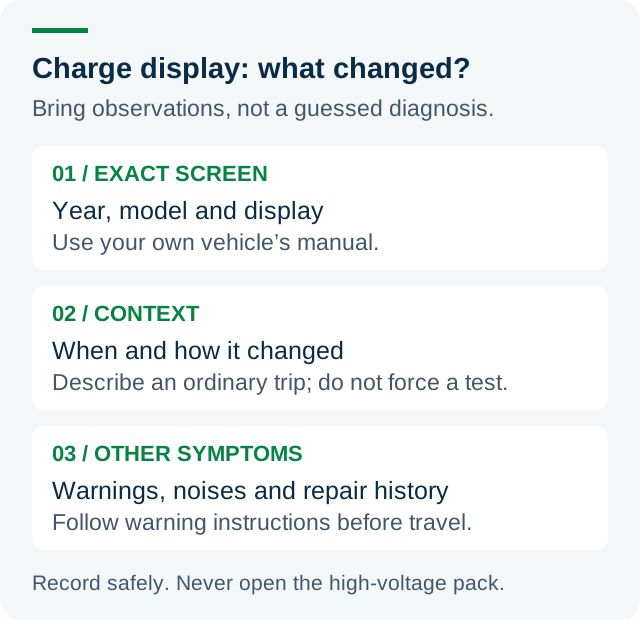
“It moves quickly” means different things to different people. Give a simple sequence: what the display showed at the beginning, approximately how long the change took, and what you noticed afterward. An observation during an ordinary trip is useful; you do not need to repeat a troublesome event to make the account more convincing.
Note whether the car had just started, was moving or stopped, and whether the road was uphill, downhill or level. Include any warning message, unusual fan noise, loss of power or recent repair. These are observations for the shop to interpret, not a checklist that diagnoses a particular component.
If you record the display, do so only when safely parked, or have a passenger make observations without distracting you. Do not hold a phone while driving, deliberately drain the battery, force charging or try to reproduce a warning on the road. A brief written account is enough to begin the conversation.
Keep earlier invoices and scan reports. State whether the battery was repaired or replaced, when the behavior began and whether anyone cleared codes. If there is no scan report, say so. A precise description of what you actually know is more useful than assigning a fault code from an internet example.
What if a warning appears at the same time?
Treat the warning instructions separately from the gauge movement. In the Prius manual cited above, the charge-warning discussion includes a buzzer and directs the driver to follow the displayed message. A changing gauge does not cancel a warning, and a reassuring-looking gauge does not override instructions to stop.
Read the exact message and follow your vehicle’s manual. If it tells you to stop, stop safely. If you experience substantial loss of power, smoke or a burning smell, stop safely and arrange assistance. Do not continue toward the shop simply because a booking is available. The display alone cannot establish that a trip from Woodbridge is safe.
When calling, distinguish “the bars changed” from “the car gave this warning.” If both happened, explain the order. If a scan has already identified P0A80, use the code-specific guide alongside the report rather than treating this general display article as an explanation of that particular fault.
What should a diagnostic visit establish?
Ask the shop to connect its findings to the concern you reported. Was the behavior observed, and under what conditions? Which checks apply to this vehicle? What is established, and what remains uncertain? A result that explains the complaint is more useful than an unexplained declaration that a battery is good or bad.
If the behavior cannot be reproduced during the visit, discuss the next step rather than assume there is no problem. Supply the original circumstances and ask whether further observation or testing is appropriate. Do not create your own stress test or open the high-voltage battery to gather information.
If repair or replacement is proposed, ask what evidence supports that scope. Identify what will be replaced or retained, how the result will be checked and which written coverage applies. A quote should address the confirmed problem on your vehicle, not merely the appearance of the charge display.
The FTC recommends written repair estimates and understanding diagnostic charges and warranty terms. At Triton, diagnosis is included with the repair; agree on standalone testing charges beforehand. Cost depends on the vehicle, root cause, parts and labor. Battery repair coverage is one year, and replacement coverage is three years / 50,000 miles, subject to written terms. Ask separately about other work.
Technical reference: FTC: estimates, diagnostic charges and written repair coverage.
How do I arrange service from Woodbridge?
Call (571) 325-1369 or request a quote with the year, model, mileage, symptoms and any reports. Explain whether you need help deciding how to transport the car. All repairs and inspections take place at 8419 Terminal Rd, Lorton, VA 22079; Triton does not offer mobile repairs or inspections.
Available visits at least 24 hours away confirm automatically. Visits less than 24 hours away require Sal’s approval, so wait for confirmation. An arrival slot does not promise diagnosis or repair completion while you wait. Plan return transportation and discuss timing with the shop.
Triton services all hybrid makes and models, Tesla electric vehicles and regular gas vehicles, but no diesel vehicles. The examples in this article do not prescribe a procedure for every system. Sharing the exact vehicle helps keep the discussion relevant to the car you are bringing.
Questions to bring to the shop
- Which screen changed, and how did it differ from this car’s usual behavior?
- Were there warnings or other symptoms at the same time?
- What findings support the proposed work?