Hybrid battery cooling · A Triton guide
Published
Why is my Prius battery cooling fan so loud?
Hearing your Prius battery fan does not, by itself, mean the battery has failed. Some fan sound is normal, but a new persistent noise deserves attention, especially with a warning or reduced power. The useful question is whether cooling is working correctly and what condition the battery is in. For Fairfax-area drivers, this guide explains what to record and what to ask before approving cooling-system work or a battery replacement.
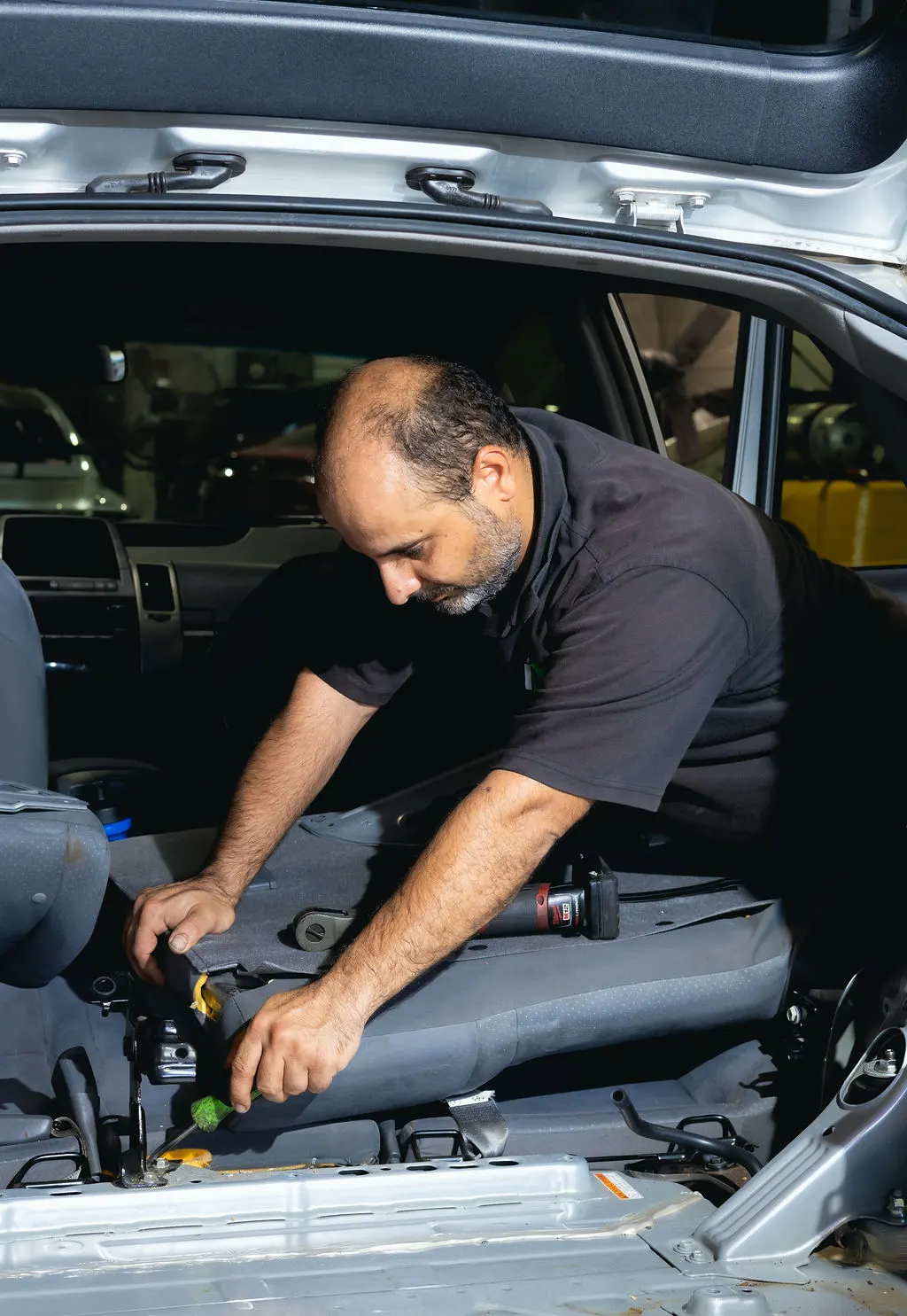
Existing Triton shop photograph of professional Prius service. It does not document a cooling-fan fault or show a procedure for owners to follow.
Is it normal to hear the battery fan?
Yes, depending on the vehicle and conditions. The 2024 Prius owner’s manual lists cooling-fan sound from the rear-seat intake among normal hybrid operating sounds. That observation does not establish that a newly loud fan on your car is normal, nor does it identify every noise near the rear seat as the battery fan.
Think about what changed. Is the sound a steady rush of air, a new rattle, or something you notice only at startup? Did it begin after a repair, a long period parked or a change in what you carry? A clear description gives the technician a starting point without turning a sound into a diagnosis.
Do not compare loudness alone with a phone video of another Prius. The recording position and vehicle may differ. Ask the shop to identify the sound source first, then explain whether its behavior fits your particular car.
Technical reference: Toyota: 2024 Prius owner’s manual OM47E80U, page 72.
Why do the model and year matter?
Prius, Prius c, Prius v and plug-in versions should not be treated as one cooling layout. Send the year, full model name and VIN when arranging service. A photograph of a different generation is not enough to locate the correct vent or choose a replacement part.
For a specific example, the 2024 Prius manual locates its battery-cooling intake under the left side of the rear seat. Toyota’s earlier technical review describes cabin-air cooling with the pack behind the rear seat on the vehicle it calls the 2003 Prius. These are different configurations, not interchangeable location instructions.
This also matters if someone has already serviced the battery. Bring the invoice and any information about the installed pack or cooling parts. The shop can check the actual vehicle rather than assume all equipment still matches an online picture or the original build.
- Technical reference: Toyota: 2024 Prius manual, page 77.
- Technical reference: Toyota Technical Review Vol. 54 No. 1, November 2005, printed page 64: earlier Prius cooling layout.
Could a blocked vent or dirty filter be involved?
Restricted cooling is worth investigating. In the 2024 Prius, Toyota warns that a blocked intake can interfere with battery cooling and restrict output. Keep luggage or seat covers from obstructing the identified intake. Its maintenance guidance also warns against water, compressed air and reaching inside; leave internal fan and high-voltage work to a qualified technician.
A visible obstruction is a useful finding, but it does not tell you the whole history. Note what was covering the area and whether the noise or warning began before or after it was moved. Do not promise yourself that removing an item has repaired an existing fault.
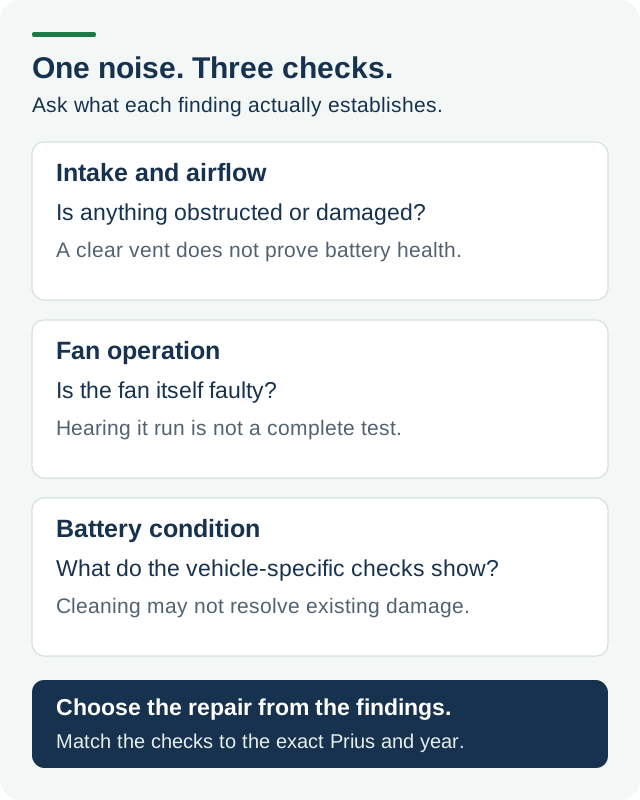
Ask the shop to separate three questions: is the air path restricted, is the fan operating as intended, and does the battery have a separate or resulting problem? A proposal that answers only one of those questions may leave uncertainty about the others.
Technical reference: Toyota: 2024 Prius manual, pages 77 and 443–445.
Can I keep driving if the fan is loud?
A noise description cannot establish whether your car is safe for the trip. Read the whole dashboard message and follow your model’s instructions. If it directs you to stop, stop safely. Significant power loss, smoke or a burning smell also means you should stop safely and arrange help instead of trying to reach the shop.
A cooling-maintenance message needs attention even if the car still moves. Report its exact wording and any other warnings when you call. A photograph taken while safely parked is useful; do not handle your phone while driving or make an extra trip just to reproduce the complaint.
Before leaving Fairfax for Lorton, tell the shop whether the car can be driven normally or may need transport. Arrange a suitable towing service when necessary and coordinate the arrival. A booking confirmation is not a judgment that the vehicle is safe to drive.
What should a professional diagnosis establish?
Ask for findings that connect the complaint to the proposed work. Depending on the model and symptoms, useful questions concern the intake and ducts, the fan’s operation, battery-temperature information and any stored fault codes. The technician should explain which checks apply, what they showed and what still needs investigation.
A scan result and a photograph answer different questions. Codes can identify a fault condition to investigate; an image can show an obstruction or damaged part. Neither should be presented as a complete explanation without the relevant vehicle checks. Request copies of existing reports and share them if another shop has already looked at the car.
If the noise is intermittent, discuss how the shop will assess it and what happens if it does not occur during the visit. “We could not reproduce it” and “we confirmed the system works correctly” are different conclusions. Agree on the next step before authorizing additional work.
Will cleaning the fan fix it, or do I need a battery?
The answer depends on the findings. Toyota bulletin T-SB-0074-20 describes specified battery fault codes associated with debris in cooling fans or filters on listed vehicles, including several Prius model years. Its procedure includes battery replacement for the stated condition as well as cooling-system work. Cleaning alone is not a universal remedy.
That August 2020 bulletin is a documented example, not a diagnosis for every loud fan or proof of current warranty coverage. It directs technicians to the applicable repair manual and actual vehicle. Ask the shop to confirm current applicability rather than apply an old bulletin based only on the Prius name.
A limited cooling repair may be appropriate when the evidence supports it. If battery repair or replacement is recommended, ask what establishes the battery fault and whether the cooling problem is also being addressed. Conversely, if only cleaning or a fan is proposed, ask how the shop will verify the result and whether any battery concern remains.
Technical reference: Toyota T-SB-0074-20, pages 1–3 and 6: specified fault conditions and cooling work.
Compare battery repair and replacement once the condition is known
What else should I ask before approving work?
Does lower gas mileage prove the battery is bad? No single symptom settles that decision. Tell the technician about the change, along with warning messages and the noise history, and ask what findings support the recommendation. Do not select a battery from a symptom checklist alone.
Should the fan be replaced just because it is audible? Not on that evidence alone. Ask whether a fault in the fan has been established or whether it is operating in response to another condition. A new part should address an identified problem, not simply make an unexplained complaint temporarily quieter.
Can I get a firm quote before testing? The vehicle, root cause, access, parts and labor affect the scope. At Triton, diagnosis is included with the repair; agree on any standalone testing charge beforehand. Ask for a written estimate, authorization for additions and the warranty that applies to the specific work.
Technical reference: FTC: written estimates, diagnostic charges and repair warranties.
How do I arrange Prius service from Fairfax?
Send Triton the year, model, mileage, exact warning text and a short account of when the sound occurs. Mention previous battery work and include the estimate if you want another assessment. Call (571) 325-1369 or use the quote form to discuss the next step.
Service takes place at 8419 Terminal Rd, Lorton, VA 22079. Plan your return transportation when leaving the car. Available visits at least 24 hours away confirm automatically; visits less than 24 hours away need Sal’s approval, so wait for confirmation. An arrival slot does not promise that testing or repair will be completed while you wait.
Triton services all hybrid makes and models, Tesla EVs and regular gas vehicles, but no diesel vehicles. This guide’s Toyota examples do not describe every hybrid or Tesla cooling system. All repairs and inspections take place at the shop.
Questions to bring to the shop
- Which component is making the noise, and what confirms it?
- What did the airflow, fan and battery checks each establish?
- Will the proposed work address every confirmed fault?
- What verification and written warranty are included?
Get help with your vehicle in Northern Virginia
Hybrid battery diagnosis and repair
Discuss the findings before choosing battery work.
Prius battery replacement
Review a vehicle-specific replacement proposal when the diagnosis supports it.
Battery repair or replacement?
Understand the options, parts and written coverage.
Service for Fairfax drivers
Arrange records, drop-off and transport to our Lorton shop.