Cooling system and engine diagnosis · A Triton guide
Published
Why is my car losing coolant with no visible leak?
A falling coolant level can point to a leak you have not located, a cap or cooling-system problem, or an internal engine fault. No puddle does not establish a failed head gasket, and it does not clear the car for continued driving. Start by confirming how the level is changing, then investigate where the coolant is going. For Fairfax drivers considering a major engine repair, the useful first question is what the evidence actually confirms.
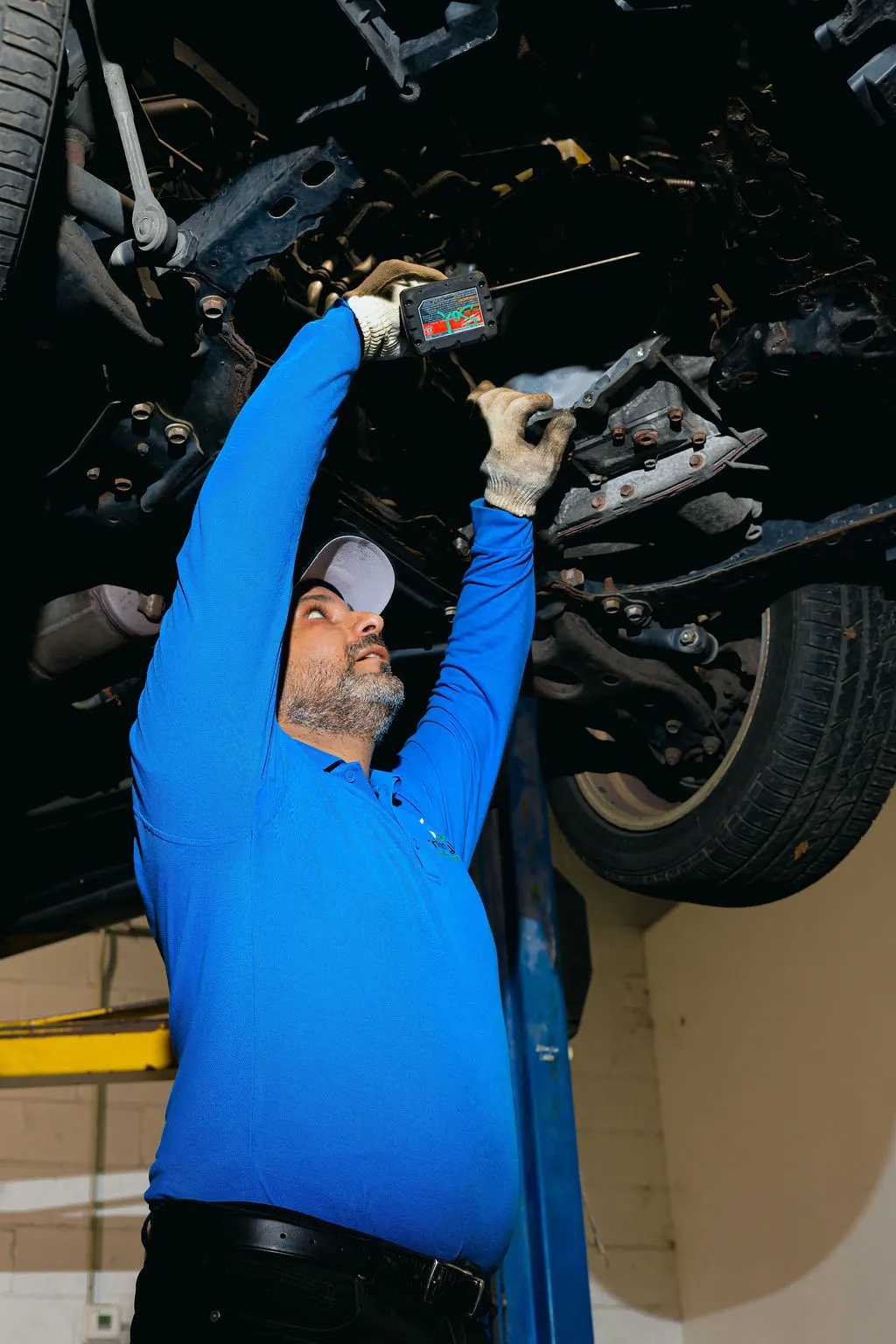
Existing Triton workshop photograph. It shows a vehicle inspection, not a documented coolant leak or a customer repair described in this guide.
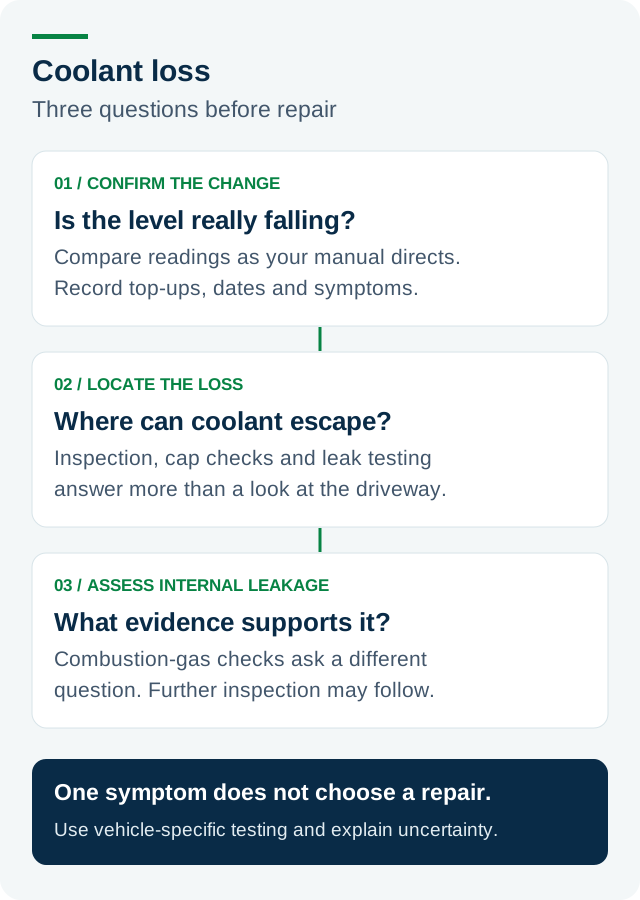
Is the coolant actually disappearing?
Compare levels under the conditions specified in your own owner’s manual. Ford explains that coolant expands as it heats up, so a hot reading and a cold reading are not directly comparable. On a vehicle with more than one cooling circuit, identify which reservoir you are observing rather than assuming every tank serves the engine.
For a concrete model-specific example, the 2023 Toyota Highlander manual checks engine coolant between the reservoir’s marked limits with the engine cold. It also warns against removing a hot reservoir or radiator cap because pressurized coolant can cause serious burns. Follow the instructions for your exact vehicle; reservoir layout and the correct fluid specification vary.
Keep a short record instead of relying on memory. Photograph the visible reservoir level when it is safe to do so, note the date and mileage, and tell the shop whether someone has added coolant since the previous reading. Include recent cooling-system work. You do not need to open a hot system or crawl underneath the car to prepare a useful report.
- Technical reference: Ford owner’s manual: Engine Coolant Check, temperature and reservoir guidance.
- Technical reference: Toyota: 2023 Highlander manual OM0E055U, Checking the coolant.
What tests help find missing coolant?
The test should answer a defined question. HELLA’s cooling-system checklist starts with fluid level, condition and leaks, and includes checking the pressure cap’s seal and valve operation. It also distinguishes actual coolant temperature from what a dashboard display reports. Which checks are relevant depends on the complaint and vehicle.
A cooling-system pressure test looks for loss from the system; a combustion-gas test looks for exhaust gases entering it. Block Tester, the maker of a chemical combustion-leak tester, explains this distinction. These tests are not interchangeable, and one result is not a complete assessment of every engine component.
Test conditions matter. Block Tester notes that intermittent leakage, engine load and contamination of the test fluid can affect interpretation. Tell the shop about recent coolant additions and when symptoms occur. Ask whether a result reproduced the complaint and what uncertainty remains, rather than treating a single test as a universal pass or fail.
Leave pressurizing the system and sampling it to the technician. This guide explains the questions behind diagnosis; it does not provide a pressure setting, cap-opening procedure or test sequence for your car.
- Technical reference: HELLA: cooling-system checks, temperature indication and pressure-cap assessment.
- Technical reference: Block Tester: pressure testing versus combustion-gas testing and test limitations.
Does unexplained coolant loss mean a blown head gasket?
It is a possibility, not a conclusion. Fel-Pro lists unexplained coolant loss among symptoms shared by a damaged head gasket and a cracked cylinder head. Other possible clues include overheating, white exhaust smoke, oil contamination and rough running. Report any accompanying symptoms; their presence or absence is not a complete diagnosis.
Fel-Pro explains that distinguishing a damaged gasket from a cracked head can require removing the head and having it inspected or pressure-tested by a machine shop. A combustion-leak finding therefore does not, by itself, describe the full repair scope. Ask what is established before disassembly and what can only be assessed afterward.
If internal damage is confirmed, discuss whether a defined repair is appropriate or whether broader engine work needs consideration. Ask why each option is being proposed. Our separate overheating and rebuild-versus-replacement guides address those later decisions; they should follow an assessment of this engine, not replace it.
Technical reference: Fel-Pro: overlapping head-gasket and cracked-head symptoms, and further inspection.
Can I keep driving if the temperature gauge looks normal?
Do not use a normal-looking gauge or the absence of a puddle as clearance to keep driving a car that repeatedly loses coolant. Ford warns that running with low coolant can cause overheating and engine damage. Follow your vehicle’s warning instructions, stop safely if overheating or a stop instruction appears, and arrange suitable assistance when the vehicle cannot be driven safely.
Repeated top-ups are not a repair. Use only the coolant and filling guidance specified for your vehicle; do not choose a product by color alone. Ford also warns against stop-leak pellets, sealants and unspecified additives because they can damage cooling or heating systems. Tell the technician if any product has already been added.
Before setting off from Fairfax, call with the exact warning and symptoms. A conversation can help coordinate assessment and transport, but an article cannot guarantee that your car will reach the shop safely. If it has already overheated, say so even if the warning has disappeared.
Technical reference: Ford owner’s manual: low-coolant risks, specified coolant and additive cautions.
What should I tell the shop before bringing the car in?
Send the history you have, including an earlier diagnosis or repair estimate. Separate what you observed from what someone suspects. You can ask for an explanation of another shop’s findings without assuming its conclusion is either correct or wrong.
A useful intake note answers these questions. Missing details are fine; do not run the engine or repeat an unsafe trip just to complete the list:
- Which vehicle, engine or hybrid powertrain, mileage and reservoir are involved?
- How often does the level drop, and were the readings made under comparable conditions?
- What coolant or other product was added, by whom and when?
- Were there temperature warnings, rough running, exhaust changes or changes in cabin heat?
- What recent service, leak testing or overheating history can you document?
What should the repair recommendation explain?
Ask for the confirmed cause, the work proposed to address it and any unresolved findings. If further disassembly is needed, agree on that stage before proceeding. Ask when the shop will contact you again and what information will be available at that point.
The quote depends on your vehicle, the root cause, access, parts and labor. A leaking component and confirmed internal engine damage involve different scopes. Diagnosis is included with the repair at Triton; discuss any standalone testing charge beforehand. Do not assume testing is free if you decide against the repair.
Before approving work, ask what checks will confirm the repair and what follow-up is needed. Get the applicable warranty in writing. The shop’s hybrid-battery warranty terms do not define coverage for cooling-system or engine work.
How can Fairfax drivers arrange coolant-loss diagnosis?
Call (571) 325-1369 or send a quote request with the vehicle details and coolant-loss history. All repairs and inspections take place at 8419 Terminal Rd, Lorton, VA 22079. There are no mobile repairs or inspections. Agree on drop-off and suitable transport before moving a vehicle that may be unsafe to drive.
Available visits at least 24 hours away confirm automatically. Visits less than 24 hours away require Sal’s approval; wait for confirmation. An arrival slot does not promise diagnosis or repair completion while you wait, so arrange your return transportation separately.
Triton services gas vehicles, all hybrid makes and models, and Tesla EVs, but no diesel vehicles. The engine and head-gasket discussion here concerns combustion engines, including those in hybrids. For a Tesla cooling-system concern, provide the exact model and alert so the assessment matches that vehicle.
Questions to bring to the shop
- What evidence explains where the coolant is going?
- What did each test establish, and what remains uncertain?
- Do we need further inspection before choosing the repair?
- What work, verification and written coverage are included?
Get help with your vehicle in Northern Virginia
Engine diagnostic service
Describe the coolant loss and related symptoms before choosing parts.
Engine repair and replacement
Review major repair options when findings justify that discussion.
Repair after overheating
Understand why finding the leak and assessing damage are separate decisions.
Service for Fairfax drivers
Coordinate a visit to the one Lorton workshop.