Engine repair · A Triton guide
Published
How do I know if my engine is seized or the starter is bad?
A click, silence or an engine that will not turn over does not tell you whether the starter is bad or the engine is seized. Starting-system faults and mechanical damage need different repairs. Before approving either, ask what testing established the cause. This guide explains the distinction and helps Woodbridge drivers prepare for an assessment at Triton’s Lorton shop.
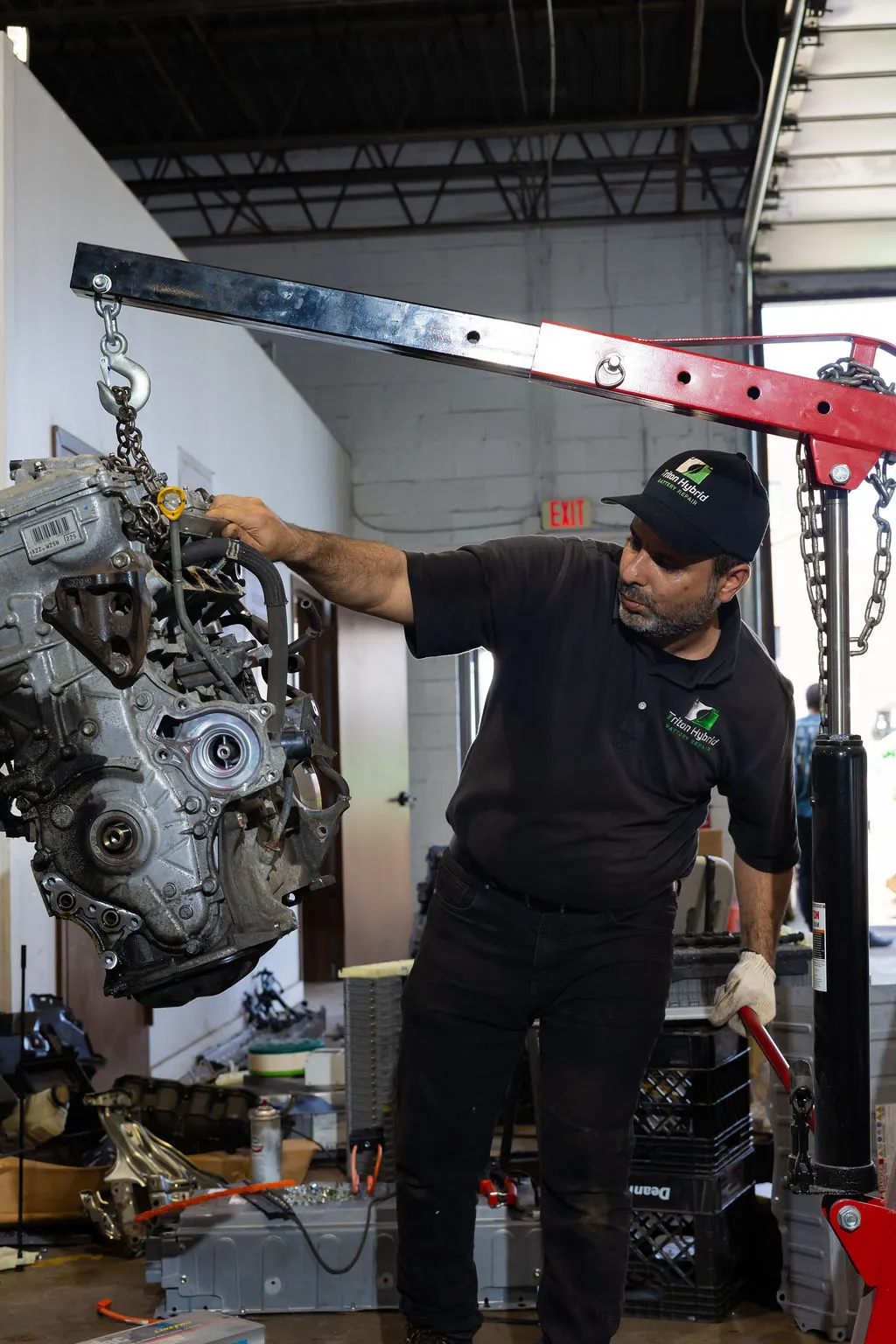
An existing Triton shop photo. It illustrates engine service, not a documented seized-engine repair or a recommendation to replace your engine.
First, separate “will not crank” from “will not start”
Cranking means the engine is being rotated to begin running. A conventional starter supplies that rotation. An engine that rotates but never begins running presents a different complaint from one that does not rotate at all. Describe what happened rather than choosing a failed part in advance.
Sound can be misleading. DENSO notes that a starter can spin without cranking the engine, turn too slowly, or fail to turn with either a noisy or silent switch. A whirring sound is therefore not proof that the engine itself is rotating. Likewise, one click is not proof that the engine is locked.
Tell the shop whether you heard silence, repeated clicks, a single click, slow uneven cranking or the usual cranking sound without the engine starting. If you already have a recording, share it. Do not repeatedly operate the starter just to obtain a better recording.
Technical reference: DENSO: starter operation and different failure symptoms.
What happened before it stopped matters
A car that would not restart after parking and one that stopped after overheating need different histories recorded. Neither description identifies the repair by itself. Write a short timeline while the details are fresh, including any work completed immediately before the problem.
Overheating can damage the lubricating film between moving engine surfaces. Motorservice’s piston-damage guidance describes how that can lead to seizure. That is one possible damage mechanism, not a conclusion about your vehicle from a temperature warning alone.
If the engine stopped with an oil-pressure warning, overheating, smoke or a severe new noise, stop further starting attempts and arrange professional advice and transport. Do not try to force the engine to rotate, bridge starter connections or hit the starter. The purpose of diagnosis is to identify the obstruction or fault without adding damage.
- Did the problem begin while driving, at a traffic stop, or on the next attempted start?
- Which warning messages appeared before the engine stopped, rather than only afterward?
- Was there recent overheating, an oil leak, water exposure or a long period without use?
- Has anyone already jump-started the car, changed the battery or replaced the starter?
- What did a previous shop actually test, and can you obtain the findings or invoice?
Technical reference: Motorservice: overheating-related piston damage.
Check the electrical starting system before choosing parts
A useful assessment considers the battery, cable connections and starting controls as well as the starter. DENSO’s troubleshooting guidance begins with battery condition and connections, then uses measurements against the vehicle manufacturer’s specifications. Dashboard lights coming on do not replace those checks.
Ask what the battery assessment and voltage-drop checks showed. Excess resistance in a cable or connection can interfere with starter operation. Where current-draw testing is appropriate, its result also needs interpretation: DENSO explains that high current with slow cranking can involve a starter fault or an engine problem.
There is no universal voltage or current number in this guide. The applicable procedure, operating conditions and limits come from the exact vehicle’s service information. A result outside a limit should lead to an explanation of the cause, not an automatic engine replacement.
Technical reference: DENSO: battery, voltage-drop and current-draw checks.
What supports a seized-engine diagnosis?
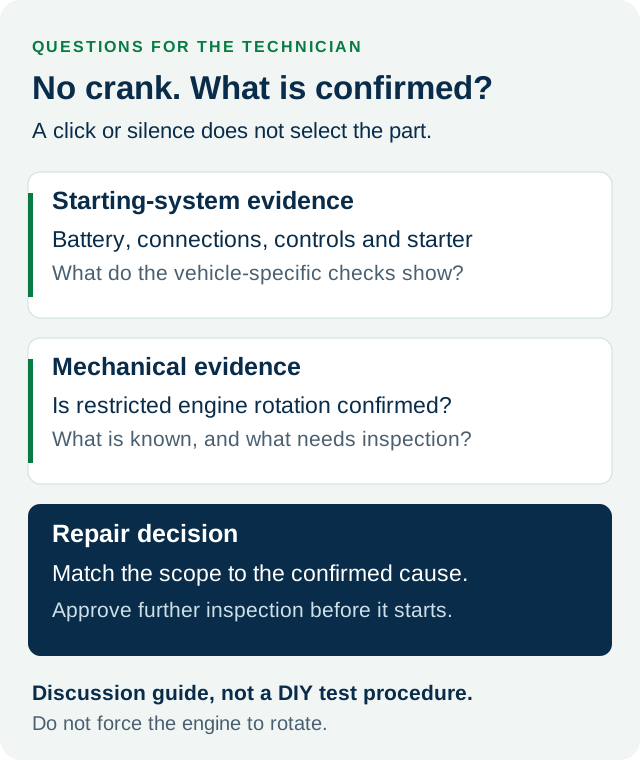
If the shop reports that the engine is mechanically locked, ask how that was established separately from a starting-system failure. Ask what is known about the internal damage and what remains uncertain. “It will not start” describes the symptom; the recommendation needs the findings behind it.
A vehicle-specific example shows why the distinction matters. GM bulletin 23-NA-170, revised September 2023, covers specified vehicles and engines, including listed 2019–2023 Silverado 1500 configurations. It describes some seized engines with an open starter fuse and identifies crankshaft-bearing failure as a possible cause. For confirmed internal concerns, it discusses inspecting oil and filter debris and, when indicated, further bearing inspection.
That bulletin does not diagnose every Silverado, every no-crank condition or a Toyota. It illustrates that an electrical symptom can coexist with internal engine damage. The shop should use current information for the VIN and engine; do not assume a bulletin establishes recall coverage or a free repair.
If more disassembly is needed, agree on its scope before it starts. Request a clear distinction between what has been confirmed, what the inspection could reveal and when you will be contacted for the next decision.
Technical reference: GM bulletin 23-NA-170: specified seized-engine and starter-fuse concerns.
A quiet hybrid engine needs a different starting point
Do not apply a conventional starter-motor comparison to every hybrid. For example, Toyota’s Prius Plug-in Hybrid manual OM47856U states on page 241 that the vehicle can move with READY illuminated even while the gasoline engine is stopped. Silence under the hood, by itself, is not evidence of seizure on that system.
For a hybrid, report the exact model and year, whether READY appears and the complete warning message. Use the manual applicable to that vehicle; the Prius example is not a universal starting procedure. Leave high-voltage equipment alone. A vehicle that does not become ready to drive needs its own diagnostic assessment.
Technical reference: Toyota Prius Plug-in Hybrid manual OM47856U, pages 48 and 241.
Understand a Check Hybrid System warning before choosing a repair
What should come before a starter or engine quote?
The proposed work should match the confirmed fault. If the evidence supports a starting-system repair, ask which component or connection needs attention and how the result will be checked. If internal engine damage is confirmed, ask whether further inspection is needed before comparing repair, rebuilding or replacement.
The FTC recommends a written estimate identifying the condition, needed parts and anticipated labor, with approval arrangements for additional work. For an engine proposal, also ask how the original cause will be addressed, what related work is included and what findings could change the scope. Get the applicable parts and labor warranty in writing.
At Triton, the quote depends on the vehicle, root cause, damage, parts, access and labor. A no-crank symptom cannot support a meaningful public price or range. Diagnosis is included with the repair; ask about standalone testing or inspection charges before committing to that work.
Technical reference: FTC: written estimates, diagnostic charges and repair warranties.
Compare rebuilding with used or remanufactured engine replacement
Common questions when the engine will not turn over
Does a failed jump-start prove the engine is seized? No. Tell the technician what was attempted and what changed. That observation does not substitute for the starting-system and mechanical checks described above.
Can adding oil fix a seized engine? Adding oil is not evidence that damaged parts have recovered. If seizure is suspected, do not keep attempting to start it. Ask what the inspection shows and what repair would address both the damage and its cause.
Should I buy a starter before arranging diagnosis? Give the shop the symptoms and any previous findings first. Ask what supports replacing it. Buying a part in advance can leave you committed to an assumption that the assessment does not confirm.
Arrange a no-crank assessment from Woodbridge
Triton serves Woodbridge from one shop at 8419 Terminal Rd, Lorton, VA 22079. Call (571) 325-1369 or request a quote with the year, make, model, symptom timeline and previous findings. State clearly that the vehicle cannot currently be driven if that is the case.
Confirm shop availability and the drop-off arrangement before booking a tow from Woodbridge. Tell the transport provider the exact vehicle and where it is parked, including garage access restrictions. Loading and transport must follow the vehicle’s requirements; do not assume every hybrid or drivetrain can be moved the same way.
Arrange your own return transportation and discuss assessment timing without assuming a same-day repair. Triton services all hybrid makes and models, Tesla electric vehicles and regular gas vehicles, but not diesel vehicles. For this complaint, the first goal is a supported diagnosis and an approved next step.
Questions to bring to the shop
- What confirms whether the engine is cranking?
- Which findings support a starting-system fault or mechanical restriction?
- What further inspection needs my approval?
- How will the repair address the cause and be verified?
- What work, timing and written warranty am I approving?